 Call (844) NO-DISPUTES
What is an Open Loop Payment System?
Open loop systems are built on interoperability. Unlike closed loop systems, which lock spending to a single retailer or platform, open loop networks allow a payment strategy to work across virtually any merchant or service provider that accepts the same network. That distinction has giant implications for how money moves - and for the businesses and consumers who depend on it.
How these systems work matters if you're a business looking at payment options, a developer building financial products, or basically anyone thinking about the technology behind your wallet - this post breaks down what open loop payment systems are, how they function, and what sets them apart from their alternatives.
How Open Loop Payment Systems Actually Work
Every time someone taps a card or phone at a checkout, a fast chain of events runs in the background - it all happens in seconds. But a few separate parties are involved in getting that payment approved.
The person making the payment is the cardholder. The business accepting the payment is the merchant. Between those two, there are three more players doing the heavy lifting.
The card network - think Visa or Mastercard - acts as the connector - it routes the payment information between the merchant's bank and the cardholder's bank. The issuing bank is the one that gave the cardholder their card, and it's the one that approves or declines the transaction. The acquiring bank is on the merchant's side and it's responsible for receiving the funds once everything is approved.
Here is an easy overview of who does what.
| Player | Role in the Transaction |
|---|---|
| Cardholder | Initiates the payment using a card or device |
| Merchant | Accepts the payment and sends the request through their terminal |
| Card Network | Routes payment data between the issuing and acquiring banks |
| Issuing Bank | Reviews and approves or declines the transaction |
| Acquiring Bank | Receives and settles the funds on the merchant's behalf |
The whole process takes a fraction of a second from the cardholder's point of view. Behind that, the card network is doing real-time communication to make sure that the right checks happen and the money moves to the right place.
This shared infrastructure is what lets one card work across millions of merchants worldwide. No agreement between the cardholder and each individual merchant is needed - the network handles that. The merchant discount rate is part of what funds this infrastructure for every transaction that flows through it.
Open Loop vs. Closed Loop: What Sets Them Apart
A closed-loop system is the opposite of an open-loop system - it operates within a single network, with one issuer and one ecosystem. You can only use it where that operator accepts it - nowhere else.
The London Oyster card is a real-world example. For years, it was the favorite way to pay for travel across the city's buses and underground network. But it only worked within Transport for London's own system, and TfL owned the data, the infrastructure, and the rules; it's closed loop in action.
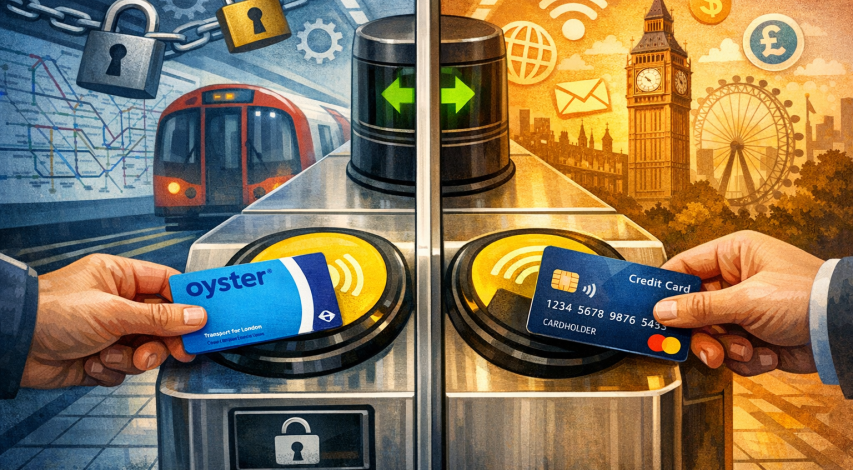
Transport for London has since moved to accept contactless bank cards and mobile wallets directly at the barrier; it's a genuine change toward open-loop payments, and it goes well with a wider pattern happening across transit systems worldwide.
The table below highlights the key differences between the two systems at a glance.
| Feature | Open Loop | Closed Loop |
|---|---|---|
| Who accepts it | Any merchant on the network (e.g. Visa, Mastercard) | Only the issuing operator or retailer |
| Who issues it | Banks and financial institutions | The operator themselves (e.g. TfL, a retailer) |
| Data ownership | Shared across the network | Held entirely by the issuer |
| Where it works | Globally, across millions of locations | Within one defined ecosystem |
| User flexibility | High - works like any bank card | Low - limited to specific use cases |
Closed-loop systems aren't inherently worse - they can be helpful for things like loyalty programs or subsidized transit passes. But they do place more control in the hands of a single operator, which limits where and how users can use their funds.
Where Open Loop Payments Are Showing Up
Transit networks have been one of the clearest proving grounds for open loop payments. Transport for London introduced contactless card payments on its bus network in 2012, then expanded the system across the Underground and rail services in summer 2015. By 2019, contactless payments had overtaken Oyster card usage, and passengers were completing 22 million trips per week with a contactless card or device.
That adoption doesn't happen by accident. London commuters were already carrying bank cards, so removing the need for a separate travel card made the whole experience easier to manage. The open loop infrastructure met them where they already were.
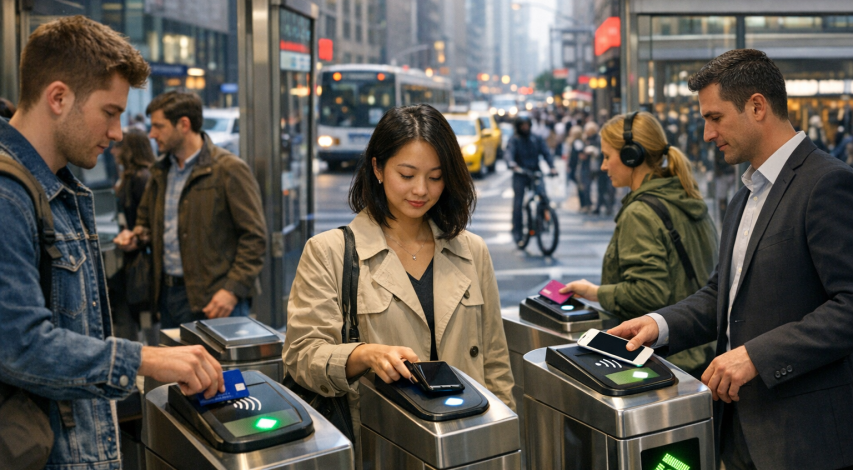
Retail has followed a similar path. Visa reported that contactless payments in the U.S. went from under 1% of credit card transactions in 2018 to over 20% by 2020; it's a fast change for an industry that moves slowly. Tap-to-pay at checkout has become a normal expectation instead of a novelty.
Hospitality is another area where open loop has gained ground. Hotels, stadiums and event venues have started to move away from wristbands and venue cards in favor of standard payment terminals. Guests can pay with whatever card or device they already use, and venues spend less on maintaining proprietary systems.
Even smaller-scale environments are making the move. Parking meters, vending machines and transit hubs in mid-sized cities have started to accept contactless bank cards where cash or tokens were once the only option. The underlying payment rails are the same ones used everywhere else, which makes integration easier for operators.
The common thread across these spaces is accessibility. Open loop systems work because the infrastructure already exists on both sides - merchants and consumers are equipped, usually without any extra steps. That reach is what makes the model worth examining across so many different industries.
The Trade-Offs: What Open Loop Gets Right and Where It Struggles
A 2024 study by Pike et al. looked at 21 California transit agencies and found broadly positive attitudes toward open loop adoption. Riders liked the convenience and agencies saw gains in boarding speed. But positive perceptions don't mean the path is smooth for everyone.
The biggest win is friction reduction. Someone who travels occasionally doesn't have to buy a transit card, load it up, and then worry about a leftover balance. They tap and go with a card they already carry.
Merchants and transit agencies also get access to better data. Transaction records from open loop systems are richer than cash or closed loop card data - it helps with planning and fraud detection.
That said, the data angle cuts both ways. Riders who value their privacy may feel nervous learning that their travel patterns are tied to their bank card; it's a basic concern and one that agencies don't always address head-on.
| What Works Well | Where It Falls Short |
|---|---|
| No separate card to manage | Not accessible to the unbanked |
| Faster boarding and checkout | Transaction fees cut into margins |
| Works with existing bank cards | Privacy concerns around travel data |
| Richer transaction data for planning | System outages can block access entirely |
The accessibility gap is worth sitting with. A large share of people globally don't have a debit or credit card, and open loop systems don't serve them without a workaround. Some agencies have paired open loop infrastructure with prepaid card programs to close that gap. But it can add complexity.
Transaction fees are another sticking point. Every contactless payment carries an interchange fee, and those costs land somewhere - on the agency, the merchant, or eventually the rider.
Reliability is also a consideration. When a contactless reader goes down or a bank's network has a problem, passengers can be left stranded in a way that a physical transit card wouldn't cause.
What Shapes Whether a Region Adopts Open Loop Payments
Not every city or region moves at the same pace, and that gap can depend on a few concrete things. Banking infrastructure is one of the biggest. If most of a population already uses contactless debit or credit cards, the groundwork is basically laid. But in regions where cash is still the default, the path to open loop is much longer.
Smartphone penetration matters too, and that's also the case as mobile wallets become a common way to tap and pay. A city where most commuters carry a capable device is a very different environment from one where that isn't the case yet - this doesn't make adoption impossible. But it does change the timeline.
Regulatory climate is another part of the challenge. Payment systems mean banking laws, data privacy laws, and transit authority agreements that all need to line up before a network can go live. Some regions have frameworks that make this easy, and others have fragmented laws that slow everything down.
Transit authority buy-in is an underrated factor. A city's transport operator has to be willing to replace or upgrade its core infrastructure, negotiate with payment networks, and manage the transition for millions of riders; it's a large institutional commitment and not all operators are positioned to take it on quickly.
Public trust plays a quieter but significant role. In places where people are comfortable using a bank card for purchases, it can feel natural to add transit to that habit. Where there is wariness around financial data, adoption moves more cautiously.
The contactless payments market is expected to grow at a 19.1% CAGR from 2022 to 2030, which explains why this conversation is accelerating across so many regions at once. More players want in, and more governments are paying attention. Readiness doesn't look the same everywhere, and that variation is worth sitting with before assuming any one model will travel cleanly from one city to the next.
Tapping Into What Comes Next
Understanding how open loop systems work gives you a clearer picture of the decisions being made around you every day - from the transit authority picking which readers to install, to the small business owner deciding whether to upgrade their point-of-sale setup. These aren't abstract technology options. They shape who can participate and who faces extra steps.
For the commuter, the merchant looking at payment options, or anyone who has wondered in the seconds between a tap and a beep, that knowledge has real value. The infrastructure behind those moments is more deliberate - and connected - than it seems. As open loop networks continue to expand into new transit corridors, venues, and markets, the difference between learning about how they work and benefiting from them is narrowing fast.
FAQs
What is an open loop payment system?
An open loop payment system allows payments to be made across any merchant or service provider that accepts the same network, such as Visa or Mastercard, unlike closed loop systems that restrict spending to a single retailer or platform.
How does an open loop payment transaction work?
When a payment is made, the card network routes transaction data between the merchant's acquiring bank and the cardholder's issuing bank, which approves or declines the payment. The entire process completes in a fraction of a second.
What is the difference between open and closed loop systems?
Open loop systems work across millions of merchants globally, while closed loop systems only work within one operator's ecosystem. The London Oyster card is a classic closed loop example, restricted solely to Transport for London's network.
What are the main drawbacks of open loop payments?
Open loop systems exclude unbanked individuals, carry interchange fees that affect merchants or agencies, raise privacy concerns around transaction data, and can leave users stranded if payment infrastructure experiences outages.
What factors affect open loop payment adoption in a region?
Key factors include existing banking infrastructure, smartphone penetration, regulatory frameworks, transit authority willingness to upgrade systems, and public trust around sharing financial data with payment networks.