 Call (844) NO-DISPUTES
What is a Merchant Discount Rate (MDR)?
MDR is one of those terms that gets used constantly in the payments industry but rarely gets a clear explanation. It's not just a single charge - it's a bundled rate made up of a few parts, each serving a different job and going to a different party in the transaction chain.
Understanding how MDR works helps you make better decisions when picking a payment processor, negotiating rates, or figuring out why your processing costs are higher than expected. This post breaks it all down - what MDR is, how it's calculated, who gets paid, and what you can do to manage it.
How the Merchant Discount Rate Actually Works
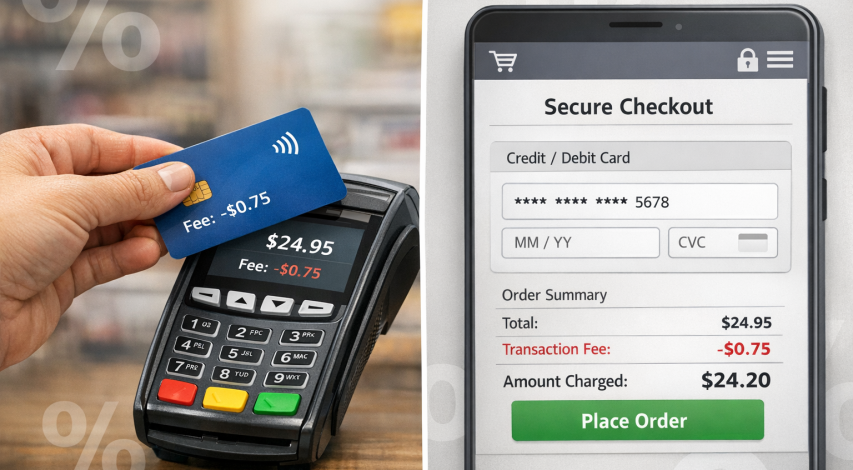
Every time a customer pays by card, the merchant doesn't receive the full sale amount. A small percentage is deducted before the money lands in the merchant's account, and that percentage is the MDR.
The rate is applied to the total transaction value, so the math is easy. If your MDR is 2.9% and a customer spends $100, you receive $97.10. The $2.90 difference is the discount - taken automatically, before settlement.
MDR rates usually fall between 1.5% and 3.5% for standard businesses, though some merchants pay more. The exact rate a business gets can depend on a few things: the type of card used, the sales volume of the business, the industry it operates in, and how the payment is processed. Card-present transactions, where the customer taps or swipes in person, draw lower rates than card-not-present ones like online purchases.
Risk plays a big part in where a merchant lands on the rate scale. Payment processors see some industries as more likely to generate chargebacks or fraud, and they price accordingly. A standard retail shop is seen as low risk. But a subscription service or travel agency sits in a higher bracket.
| Merchant Risk Level | Typical MDR Range | Example Industries |
|---|---|---|
| Low Risk | 1.5% - 3% | Retail, grocery, restaurants |
| Medium Risk | 2.5% - 4% | E-commerce, software, electronics |
| High Risk | 3% - 8% | Travel, gambling, adult content, nutraceuticals |
High-risk merchants can pay more than double what a standard retailer pays, which makes a difference at scale. A business processing $50,000 a month at 2% pays $1,000 in fees. At 5%, that same volume costs $2,500.
The MDR is a fixed cost of accepting card payments, baked into every transaction - it's worth learning about your rate, because even a fraction of a percent adds up across hundreds or thousands of sales.
Every MDR gets split three ways - between the issuing bank, the card network, and the acquiring bank. Each one plays a role in making a card payment work, and each takes a cut to cover that role.
The issuing bank takes the largest share. It is the bank that gave the customer their card, and it carries the most financial risk in the transaction. If a customer disputes a charge or defaults on their credit balance, the issuing bank absorbs that loss. That risk justifies a cut that usually lands between 1.5% and 2.5%, which is known as the interchange fee.
The card network - Visa, Mastercard, or similar - takes a much smaller slice. Its job is to move the transaction data between the two banks and to guarantee that both sides follow the rules of the payment scheme. Without it, there's no common infrastructure for the payment to travel through. The network's fee is usually a fraction of a percent, but it piles up fast across billions of transactions.
The acquiring bank sits on the merchant's side of the equation - it holds the merchant's account, processes incoming payments, and takes on some settlement risk if anything goes wrong before funds are confirmed. Its portion of the MDR reflects that responsibility.
A simple overview shows how a 2% MDR could be divided across a single £100 transaction.
| Party | Role | Approximate Fee | Amount on £100 |
|---|---|---|---|
| Issuing Bank | Extends credit, carries fraud and default risk | 1.60% | £1.60 |
| Card Network | Provides payment infrastructure and scheme rules | 0.20% | £0.20 |
| Acquiring Bank | Processes payment and manages merchant account | 0.20% | £0.20 |
| Total MDR | 2.00% | £2.00 |
Remove any one of these parties and the payment doesn't happen - which is why each fee exists. Merchants pay for a chain of services, not just a single convenience.
What Pushes Your MDR Up or Down
Your MDR is not a fixed number that applies to every business equally. Several variables feed into the final rate you pay, and some of them are within your control.
The type of card your customer uses is one of the biggest factors. A basic debit card costs less to process than a premium rewards credit card because the card issuer needs to fund those rewards somehow. That funding comes through higher interchange fees. When a customer taps a rewards card at your terminal, you absorb more of that cost than you would with a standard card.
How the transaction happens matters just as much as which card is used. An in-person tap or chip payment carries less fraud danger than an online purchase, so processors treat them differently. When a card is not physically present - like in an e-commerce checkout - there's no way to verify the card is in the right hands, which makes the transaction riskier for everyone involved. That added danger translates into a higher processing fee for the merchant.
Your industry also factors in. Businesses in categories that see more chargebacks or fraud - like travel, electronics, or subscription services - are rated as higher danger and charged accordingly. A grocery store and an online gaming platform won't pay the same rate, even if they process the same dollar volume.
Transaction volume does affect what you pay. Merchants who process large amounts each month have more leverage with processors and can sometimes access lower rates. Smaller businesses with lower throughput sit at standard rates with less room to move.
The processing method itself can add another layer. Keying in a card number manually - even in person - is treated the same way as an online transaction because the card is not being read. Contactless and chip transactions are the cheapest to process because the technology makes fraud much harder to pull off.
Merchants who don't know these variables pay more than they need to. A rate that feels standard may be higher than necessary based on how your business operates or what payment methods you accept. Understanding what shapes your MDR is the first step to doing something about it.
How Merchants Can Negotiate or Reduce Their MDR
A 0.25% reduction in your MDR might not sound like much. But on $1 million in annual sales that's $2,500 back in your pocket; it's worth a conversation with your acquirer.
Most merchants don't realise their rate is negotiable. Acquirers set rates based on perceived risk and expected volume, so if your business has grown or your chargeback rate has stayed low, you have grounds to ask for a better deal. Bring your processing history to the table and make the case with numbers.
Volume is one of the strongest levers you have. The more you process, the more interesting you are as a client, and acquirers will price accordingly. If you're spread across multiple payment providers, consolidating your volume with one acquirer can put you in a stronger position to negotiate.
It's also worth looking at interchange optimisation, which means making sure your transactions qualify for the lowest possible interchange tier by sending clean transaction data to card networks. Missing or incorrect data can push a transaction into a higher interchange category and quietly raise your effective MDR without you noticing.
Surcharging is another path; it's permitted by law and it passes some of the card processing cost on to the customer. It's not right for every business and you'll have to follow strict rules around disclosure. But it can meaningfully cut back on your net cost of acceptance in the right context.
Read your contract before you sign anything or renew. Some acquirers bury fees like statement fees, PCI compliance fees, or monthly minimums in the fine print. These don't show up in the headline MDR but they inflate what you actually pay. Your effective rate - total fees divided by total sales - is the number that tells the story.
If renegotiating feels uncomfortable, getting a competing quote from another acquirer is a basic move. A quote from a competitor gives you something concrete to work with. Acquirers know that switching costs are real but not prohibitive, and a credible alternative moves the conversation forward faster than any other strategy.
Keeping More of What You Earn
The opportunity here is scale. Shaving even a fraction of a percentage point off your MDR might feel small on a single transaction. But across hundreds or thousands of sales, it can add up to real money staying in your business; it's worth a phone call.
Pull up your last few processing statements, find your effective rate, and compare it against the latest market benchmarks. Then reach out to your payment processor with questions about interchange optimization, your pricing model, and whether your rate still makes sense for your processing volume and risk profile. Treat MDR the same way you'd treat any other operating cost: something to understand, review regularly, and keep as lean as possible. You've got better uses for that money.
FAQs
What is a Merchant Discount Rate (MDR)?
MDR is the percentage deducted from each card transaction before funds reach a merchant's account. It typically ranges from 1.5% to 3.5% for standard businesses, and covers fees split between the issuing bank, card network, and acquiring bank.
Who receives a share of the MDR?
The MDR is split three ways: the issuing bank takes the largest share (covering fraud and default risk), the card network takes a small fraction for infrastructure, and the acquiring bank takes a portion for processing and managing the merchant account.
Why do high-risk merchants pay more MDR?
Industries with higher chargeback or fraud rates - like travel, gambling, or subscriptions - are considered riskier by processors, who charge higher MDR to offset potential losses. High-risk merchants can pay rates between 3% and 8%.
Does card type affect MDR?
Yes. Premium rewards credit cards carry higher interchange fees than basic debit cards, as issuers recover rewards program costs through those fees. Card-not-present transactions, like online purchases, also attract higher rates than in-person payments.
Can merchants negotiate a lower MDR?
Yes. Merchants with strong processing volume, low chargeback rates, or a competing processor quote have real leverage to negotiate. Interchange optimisation and consolidating volume with one acquirer can also help reduce your effective rate.