 Call (844) NO-DISPUTES
What is a Credit Card Processing Discount Rate?
The term itself is a bit misleading. Despite the word "discount," there's nothing especially favorable about it from a merchant's perspective - it's basically the fee that payment processors charge for taking care of card transactions on your behalf - covering everything from network infrastructure to fraud protection.
Understanding how the discount rate works, what it includes, and why it changes between businesses can make a difference in how you review payment processors and negotiate your rates - this post breaks it all down in plain language so you can strategize your processing costs with confidence.
What the Discount Rate Actually Means for Your Business
The word "discount" does misleading work here - it sounds like you're getting a deal. But the discount rate is the fee you pay every time a customer swipes, taps, or dips a card at your register. Think of it as the cost of admission to accept card payments.
That cost adds up across the entire economy in a very real way. U.S. credit card businesses earned $148.5 billion in processing fees in 2024 alone. To put that in human terms, the average American family paid close to $1,200 in swipe fees that same year - without realizing it.
Merchants pay the fees, but pass them along through higher prices on goods and services. That means your customers may be funding your processing costs without ever seeing a line item for it.
As a business owner, the discount rate shows up as a percentage taken from each transaction before the money hits your account. If your rate is 2.5% and a customer pays $100, you receive $97.50. The processor keeps the rest and distributes it across the parties involved in making that transaction happen.
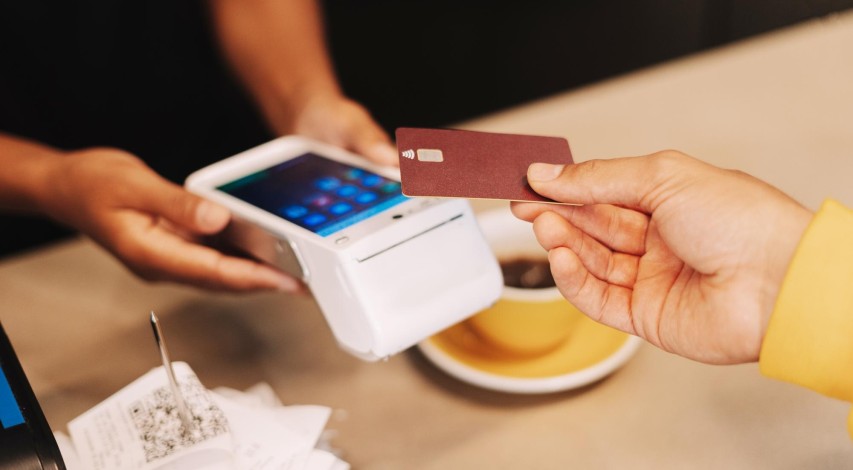
The rate itself is not one flat fee from a single source - it's a bundled number that combines a few different charges into one clean percentage, and each charge comes from a different place with a different job. That bundling is what makes the discount rate feel abstract. If you're on a high-risk payment processor, those bundled rates can look quite different from standard merchant accounts.
The next section breaks down what gets rolled into that number and where each portion goes.
The Three Fees Rolled Into One Discount Rate
That single percentage you see on your statement is three separate fees stacked together, and each one comes from a different source and goes to a different pocket.
The first layer is the interchange fee, which goes directly to the bank that issued your customer's card. It's the biggest slice and it changes based on card type, transaction method, and industry. Interchange rates usually fall between 1.15% and 3.25% plus a flat $0.10 per transaction. A rewards card or a keyed-in transaction will land at the higher end of that range.
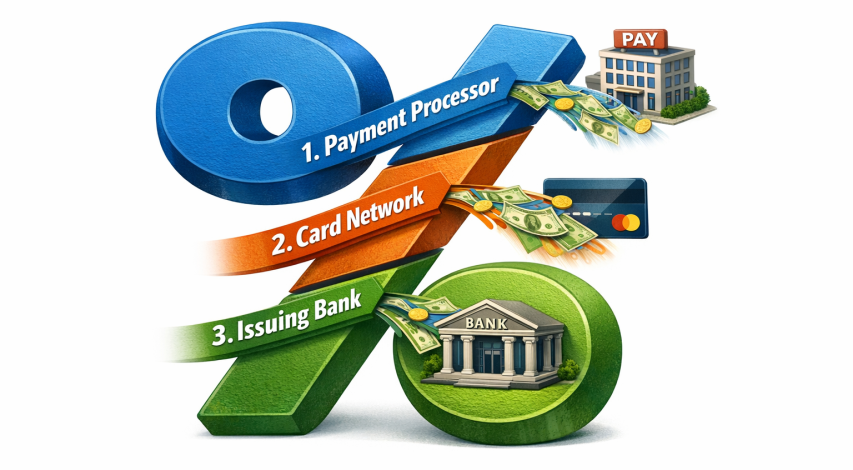
The second layer is the assessment fee, grabbed by the card networks like Visa and Mastercard. Think of this as the cost to use their payment rails - it's much smaller - usually somewhere around 0.10% to 0.15% - and it doesn't change based on how you process.
The third layer is the processor's markup: what your payment processor charges for their service, and it's the only part of the rate that's negotiable. The markup can be a percentage, a flat fee, or both, depending on how your pricing is structured. If you're in a high-risk category, understanding what counts as a good rate for a high-risk MID can help you evaluate whether your markup is reasonable.
| Fee Type | Who Charges It | Typical Range |
|---|---|---|
| Interchange Fee | Card-issuing bank | 1.15%-3.25% + $0.10 |
| Assessment Fee | Card network (Visa, Mastercard, etc.) | 0.10%-0.15% |
| Processor Markup | Your payment processor | Varies by agreement |
Most merchants see one blended number and believe that's just the cost of doing business. The layers underneath that number are where the difference between a fair rate and an inflated one lives.
How Discount Rate Models Differ by Pricing Structure
Not every processor charges the same way, and the model they use changes how your discount rate is calculated. The three main structures you'll run into are flat-rate, interchange-plus, and tiered pricing.
Flat-rate pricing is the simplest to understand. You pay one fixed rate on every transaction regardless of the card type or how it's processed. Square, just to give you an example, charges between 2.87% and 4.35% depending on the transaction type - it's predictable. But you don't benefit when interchange costs are lower than usual.
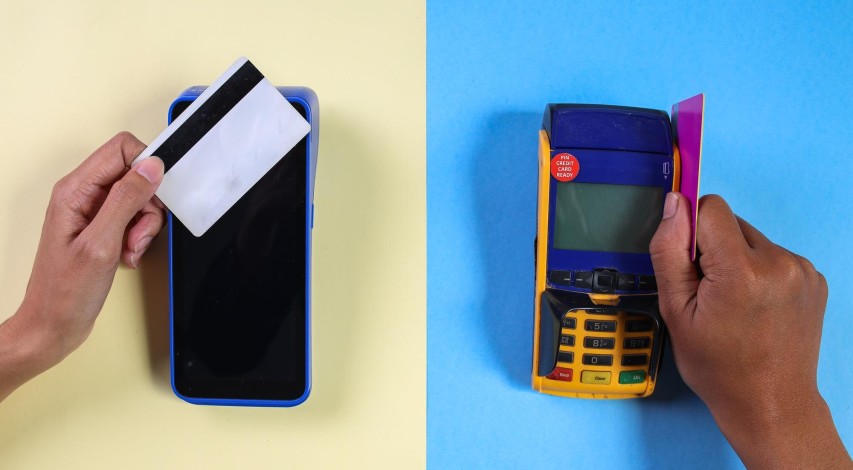
Interchange-plus pricing separates the interchange fee from the processor's markup so you can see what you're paying for. Helcim uses this model and averages around 1.93% + $0.08 per in-person transaction and 2.49% + $0.25 for online transactions. That difference reflects the higher risk processors associate with card-not-present sales. This model can save money for businesses with higher volumes because the markup stays fixed while the interchange can work in your favor.
Tiered pricing is the most variable of the three. Processors sort transactions into buckets - qualified, mid-qualified, and non-qualified - and charge different rates for each. But the processor decides which bucket a transaction falls into, which makes it harder to predict your costs.
| Pricing Model | How It Works | Typical Rate Range | Best Fit For |
|---|---|---|---|
| Flat-Rate | One fixed rate on all transactions | 2.6%-4.35% | Small or low-volume businesses |
| Interchange-Plus | Interchange cost plus a fixed markup | 1.5%-2.9% + small per-transaction fee | Mid-to-large volume businesses |
| Tiered | Transactions sorted into rate tiers | 1.5%-3.5%+ depending on tier | Varies; less transparent overall |
It's worth asking if your current pricing model actually matches how your business takes payments. A retail shop processing mostly in-person transactions has very different needs than an e-commerce store running card-not-present sales all day.
What Moves Your Discount Rate Up or Down
Several things determine the exact rate a merchant pays, and some of them are within your control.
The type of card your customer uses is one of the biggest variables. Rewards cards, premium travel cards, and business cards all carry higher interchange fees than a basic debit card. You don't choose what card a customer hands you. But an upscale customer base can push your effective rate higher just by nature of how they pay.
How a transaction is processed also matters. In-person chip transactions are the lowest-danger category, so they draw the lowest rates. Keyed-in transactions - where someone reads a card number out loud or types it into a terminal - carry more fraud danger, so they cost more to process. Online sales fall somewhere in the middle, depending on the fraud tools in place.
Your business category factors in too. Processors use MCC codes to classify merchants, and some categories are seen as higher-danger than others. A subscription box company and a hardware store might process the same monthly volume but pay different base rates because of how their industries are classified.
Volume is another lever. Higher monthly processing volume gives you more negotiating power, and some pricing models automatically reward it. That said, consistency and predictability of your volume over time matter as much as hitting a threshold.
A 0.25% rate reduction on $1 million in annual sales equals $2,500 back in your pocket - a dollar difference that comes from a change you would barely see on a rate sheet. Small differences in your discount rate add up to actual money the longer you run your business.
How to Negotiate or Reduce Your Discount Rate
The good news is that your discount rate is not set in stone. Processors want your business, and that gives you more room to push back than most merchants know.
The first place to start is your pricing model. If you are on a tiered plan, switching to interchange-plus pricing is one of the easiest ways to get a fairer rate. Tiered pricing bundles costs in a way that works in the processor's favor. But interchange-plus will show you what you are paying and where. Many mid-sized merchants have saved a meaningful amount each month just by making that one change.
Volume is another lever. Processors are more willing to negotiate when you process more transactions because your account becomes more valuable to them. If your business has grown since you first signed up, that growth is worth bringing to the table in a conversation about your rate.

It also pays to clean up your transaction data. Incomplete or poorly formatted transaction data causes your payments to qualify at higher interchange categories, which pushes your rate up. Full billing data capture and address verification where possible can help transactions qualify at better rates without changing anything about how you accept payments.
And then there's the simplest step of all - actually looking at what you pay. When did you last review your processing statement? Many business owners set up a payment processor and never revisit it, which means they leave money on the table every month. Rates that made sense two years ago might not suit your current volume or the competitive options now available to you.
You don't need to accept your rate as a fixed cost. A short conversation with your processor, or a comparison with a competitor, can be enough to get a better deal.
Your Discount Rate Is a Cost You Can Actually Control
A good next step is to pull out your most recent processing statement and look at what you're actually paying. Identify which pricing model you're on, where the largest fees are coming from, and if your processor's markup is visible or bundled in a way that makes it hard to see. That alone puts you in a much stronger position when renegotiating with your current processor or looking at a new one.

Even a modest reduction in your rate adds up faster than you might expect. For a business processing $50,000 per month, shaving just 0.2% off the rate puts an extra $1,200 back in your pocket every year. At higher volumes, the results compound more. The discount rate will always be part of accepting card payments. But how much you pay within that structure is more within your control than most business owners know - including understanding whether your processor refunds fees when disputes go in your favor or how a rolling reserve might be affecting your available cash.
FAQs
What is a credit card processing discount rate?
A discount rate is the fee merchants pay every time a customer uses a card. It's a percentage taken from each transaction before funds reach your account, covering network infrastructure, fraud protection, and processor services.
What three fees make up the discount rate?
The discount rate bundles three fees: the interchange fee (paid to the card-issuing bank), the assessment fee (paid to card networks like Visa or Mastercard), and the processor's markup. Only the processor's markup is negotiable.
What pricing models do payment processors use?
The three main models are flat-rate, interchange-plus, and tiered pricing. Interchange-plus is generally the most transparent, while tiered pricing gives processors more control over how transactions are categorized and charged.
What factors affect my discount rate?
Card type, transaction method, business category, and monthly volume all influence your rate. Rewards cards and keyed-in transactions cost more to process, while higher transaction volumes can give merchants more negotiating leverage.
Can merchants negotiate their discount rate?
Yes. Switching from tiered to interchange-plus pricing, increasing transaction volume, and improving transaction data quality can all lower your rate. Regularly reviewing your processing statement helps identify savings opportunities.