 Call (844) NO-DISPUTES
What is a Credit Card Surcharge?
Businesses pay a cost every time a customer swipes a credit card. These processing fees, charged by card networks and banks, eat into a merchant's profit margins. Surcharges are one way businesses pass that cost on to the customer instead of absorbing it themselves.
Whether you're a consumer trying to know what you're being charged or a business owner thinking about adding a surcharge to your own transactions, understanding how these fees work matters - this post breaks down what credit card surcharges are, how they can vary from other fees, and what laws govern them.
How Credit Card Surcharges Actually Work
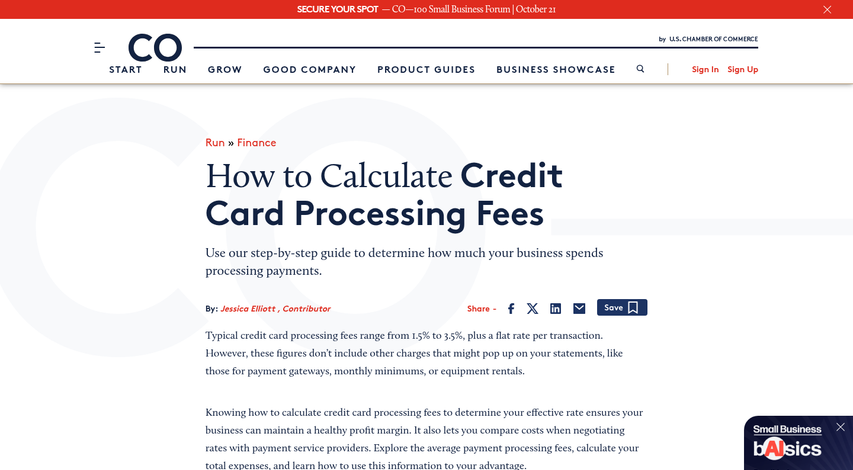
A surcharge is a fee that a merchant can add to your total to cover what their payment processor charges them to accept your card. These processing fees usually land between 1.5% and 3.5% of the transaction, depending on the card network and the type of card used.
Merchants can't simply set surcharges at whatever rate they want. Under Visa and Mastercard's 2023 rules, the cap sits at 3% - or the merchant's processing cost, whichever is lower. So if a business pays 2.1% in processing fees, that's the most they can pass on to you.
It's worth learning about the difference between a surcharge and a convenience fee, because these two get mixed up quite a bit. A surcharge applies specifically to credit card payments and it's meant to recover processing costs. A convenience fee is charged when a customer uses a payment channel that's outside the merchant's normal process, like paying a utility bill by phone instead of in person. A convenience fee can apply to debit or credit cards, and the reason for it is the channel - not the card type.
Merchants who add surcharges also have to follow disclosure laws. They need to notify customers before the transaction is complete, and in card-present situations that usually means a posted sign at the point of entry or the register. The fee also has to appear as a separate line item on your receipt.
One thing surcharges can't do is turn a profit for the merchant. The whole point of the fee is cost recovery - not a revenue stream; it's part of why the cap is tied to processing costs instead of a flat allowable percentage.
Debit cards are entirely off the table. Even if a debit card is run as a credit transaction, merchants are not allowed to apply a surcharge to it. The rules only permit surcharges on credit card transactions, full stop.
Where Credit Card Surcharges Are Banned or Restricted
Not every business in the U.S. has the freedom to add a surcharge, because the laws depend heavily on where you are. Some states have taken a hard line and banned credit card surcharges altogether. Connecticut, Massachusetts, and Maine all fall into this category, and Puerto Rico does too.
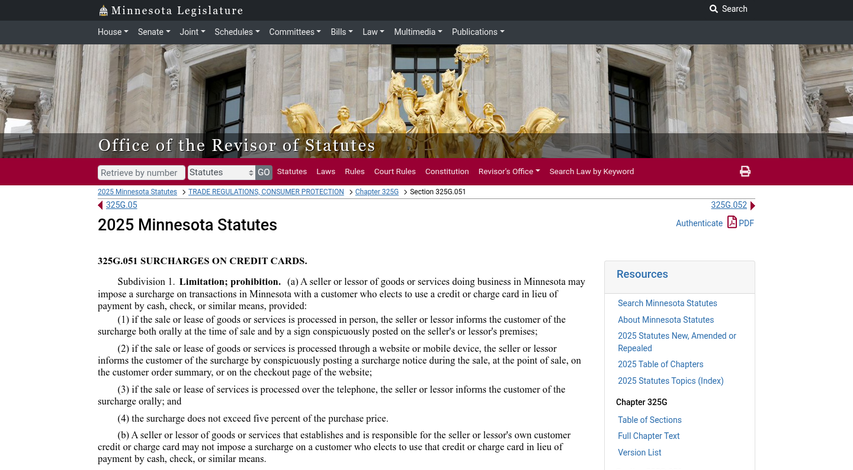
Minnesota took a different approach at the start of 2025. Rather than ban surcharges outright, the state now requires that any surcharge be built into the advertised price from the start. So if a business wants to pass on card processing fees, the price a customer sees on a menu or tag has to already include them - nothing extra gets added at checkout.
| State / Region | Surcharge Rule | Effective |
|---|---|---|
| Connecticut | Full ban | Ongoing |
| Massachusetts | Full ban | Ongoing |
| Maine | Full ban | Ongoing |
| Puerto Rico | Full ban | Ongoing |
| Minnesota | Must be included in advertised price | January 1, 2025 |
There is also a federal rule worth knowing about. The Durbin Amendment, which was passed as part of the Dodd-Frank Act in 2010, prohibits surcharges on debit card and prepaid card transactions across the entire country - this applies everywhere, regardless of state law. So even in states where credit card surcharges are legal, adding one to a debit purchase is not allowed.
For merchants, this is not a technicality. Businesses that charge surcharges in banned states or apply them to debit transactions can be looking at legal action and fines. The laws also change, as Minnesota's 2025 update shows, so what was acceptable last year might not be today. If you run a business that accepts card payments, it's worth checking your state's latest laws directly instead of relying on what you heard a while back.
Why More Businesses Are Adding Surcharges Now
The numbers tell the story. A 2024 J.D. Power survey found that 34% of small U.S. businesses now add credit card surcharges, compared to just 1-2% back in 2019. That is a dramatic change in a short amount of time.
Processing fees explain the change. Every time a customer pays by card, the merchant pays a fee to the card network and the bank - and those fees have crept up over the years. For a large retailer with high volume, that cost gets absorbed into the bigger picture. For a small business running on thin margins, it can seem like a drain on the bottom line.
Consider it from the merchant's side for a bit. A cafe owner selling a $5 coffee might pay 2.5% or more in processing fees on that transaction. That is over 12 cents per cup, which piles up fast across hundreds of sales. Passing that cost to the customer starts to look like an easy business choice instead of a cash grab.
It is also worth mentioning that small businesses don't have the same negotiating power as big retailers with these processing rates. Large chains can push back and get better deals from payment processors. A local hardware store or independent gym usually can't. Surcharges become one of the few tools available to protect their margins without raising prices across the board.
There is a wider economic story here as well. Rising costs across the board - for labor, supplies, and operations - have put pressure on small business owners in ways that were less pronounced five years ago. Card processing fees, which once felt manageable, now sit alongside a long list of costs that all compete for the same limited revenue. Some merchants in tighter situations even look into options like a high-risk merchant account when standard processors won't work for them.
Surcharges are not without criticism. But framing them purely as a consumer inconvenience misses part of the picture. The growth in surcharge use reflects the financial pressure on the businesses adding them, and that context matters when you see a fee appear at checkout.
How Surcharges Affect Customer Trust and Spending Habits
Businesses adding surcharges have a choice to make - one that goes past covering costs. The way customers respond to these fees can shape if they come back at all.
A survey by Wise and Morning Consult found that 76% of consumers said unexpected fees influenced which company they chose to go with. Even more telling, 42% stopped using a brand entirely because of fees they felt were unfair; it's a decent chunk of possible repeat business walking out the door.
A lot of it will depend on psychology. A fee added at the final step of checkout feels different from a price that had it built in from the start - by the time customers reach the payment screen, they've already committed mentally to the buy, so a new charge at that point can seem like a last-minute change to the deal. That feeling, fair or not, tends to stick.
The result is that surcharges can quietly damage things that don't show up on a balance sheet. Customers who feel blindsided are more likely to leave negative reviews, less likely to return, and more likely to tell others about the experience. Loyalty is hard to build and easy to lose.
Consumer reactions to credit card surcharges fall into a few patterns. Some pay without much thought, and that's usually small amounts. Others switch to a debit card or cash to get around the fee. And some walk away from the transaction entirely - or from the business long-term.
Transparency makes a difference here. When a business shows the surcharge before the final step, customers have time to adjust and the charge becomes a known condition instead of a penalty - it doesn't remove frustration for everyone. But it does change the tone of the interaction.
There's also a competitive angle worth thinking about. If a customer can get the same product or service nearby without a surcharge, the fee can become a reason to go elsewhere. In markets where options are plentiful, even a small per-transaction cost can be the deciding factor.
The numbers from that Wise survey are a reminder that fees are never invisible to the people paying them - even when businesses treat them as routine. Disputes tied to unexpected charges can sometimes escalate, so understanding how chargeback reason codes work is worth knowing if surcharges become a recurring friction point.
Before You Swipe - What to Do With This Information
For business owners, the way you introduce a surcharge matters almost as much as the surcharge itself. A small sign, a line item, or a quick word from staff can be the difference between a customer who understands and one who feels blindsided. Transparency does not erase the cost. But it does protect the trust you have worked hard to build.
That moment at checkout - the one that lasts only a few seconds - is about whether both sides feel respected. Knowing what a surcharge is, why it exists, and what the laws around it are puts you in a much better position, whether you are the one paying or the one collecting. Disputes that arise from unclear charges can sometimes escalate into a return item chargeback, which adds costs and complications well beyond the original transaction.
FAQs
What is a credit card surcharge?
A credit card surcharge is a fee merchants add to a transaction to cover the processing costs charged by card networks and banks. It is meant strictly for cost recovery, not profit, and must be disclosed before the transaction is completed.
How much can a merchant charge for a surcharge?
Under Visa and Mastercard's 2023 rules, surcharges are capped at 3% or the merchant's actual processing cost, whichever is lower. Merchants cannot charge more than what they pay in processing fees.
Can surcharges be applied to debit card purchases?
No. The Durbin Amendment prohibits surcharges on debit and prepaid card transactions nationwide. This applies even when a debit card is processed as a credit transaction.
Which states ban credit card surcharges?
Connecticut, Massachusetts, Maine, and Puerto Rico have full bans on credit card surcharges. Minnesota requires surcharges to be built into the advertised price rather than added at checkout.
Why are more businesses adding surcharges recently?
A 2024 J.D. Power survey found 34% of small U.S. businesses now add surcharges, up from just 1-2% in 2019. Rising processing fees and thin profit margins have pushed many small businesses to pass these costs on to customers.