 Call (844) NO-DISPUTES
What is a Credit Card Decline Rate?
Your decline rate is simply the percentage of card transactions that fail to go through successfully. A high one is not just a minor inconvenience - it can mean lost revenue, frustrated customers, and even flags from payment processors that put your account at risk.
Whether you're running an e-commerce store, a subscription service, or a brick-and-mortar shop, understanding what your decline rate is, what's driving it, and how to bring it down is one of the more helpful things you can do to protect your bottom line - this post walks you through that.
How a Credit Card Decline Rate Is Calculated
The math behind decline rates is easy. You take the number of declined transactions, divide that by the total number of attempted transactions, and multiply by 100 to get a percentage.
So if a business processes 1,000 transactions and 80 get declined, the decline rate is 8%. That number tells you what share of payment attempts are failing at the point of processing.
The word "attempted" is worth mentioning here. An attempted transaction is any payment that gets submitted to the card network for credit card authorization - it doesn't matter if the customer thinks it went through or not. The second that request is sent and a response comes back, it counts - this boundary matters because it determines what goes into your denominator and directly shapes how your rate looks on paper.
Benchmarks can vary by business type. But the numbers from Visa and Mastercard data give a helpful starting point. Average decline rates for recurring transactions sit around 15%, and some industries push well past 30%; it's not a small gap, and it goes to show how differently payment behavior plays out across sectors.
The table below breaks down common rate ranges by industry to give you a sense of where things land.
| Industry | Typical Decline Rate Range |
|---|---|
| Software / SaaS | 5% - 10% |
| Retail / E-commerce | 8% - 15% |
| Subscription Boxes | 12% - 20% |
| Gaming & Digital Media | 15% - 25% |
| Financial Services | 20% - 30%+ |
A high decline rate in one industry could be normal and would be a red flag in another. Context matters quite a bit when reading these numbers.
Why Credit Cards Get Declined in the First Place
Declines don't all happen for the same reason, and that distinction matters quite a bit. The cause of a decline shapes what you can do about it - or if you can do anything at all.
The biggest driver is insufficient funds. Around 47% of all credit card declines come down to a customer not having enough available credit or money at the time of the transaction - which is almost entirely outside a merchant's control.
Next up are issuer-side declines, which account for roughly 27% of cases, where the customer's bank comes in and blocks a transaction, usually because something about it looks unusual or potentially fraudulent. The bank may flag a purchase because of an unexpected location, it's bigger than normal, or it doesn't match the customer's spending pattern.
Then there's card data problems. Expired cards, incorrect numbers, or mismatched billing addresses make up a meaningful share of declines - and subscription businesses feel this most. When a card expires and the customer doesn't update their payment details, the next billing cycle just fails. Estimates put this category at around 18 to 20% of declines for subscription models.
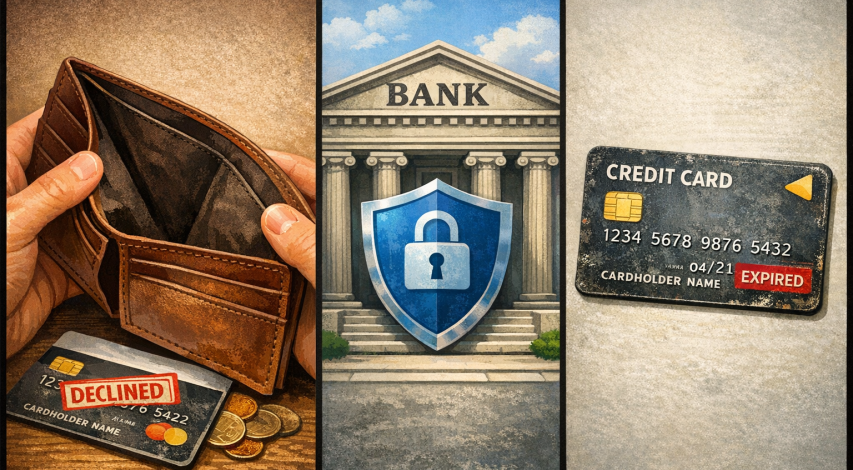
Here's a quick overview of the three main categories:
| Decline Category | Approximate Share | Who Controls It |
|---|---|---|
| Insufficient funds | ~47% | Customer |
| Issuer or fraud block | ~27% | The card issuer |
| Invalid or expired card data | ~18-20% | Merchant and customer |
That table has one column worth your attention: "Who Controls It." The card data category is the one place where merchants have the most room to act.
The Difference Between Hard and Soft Declines
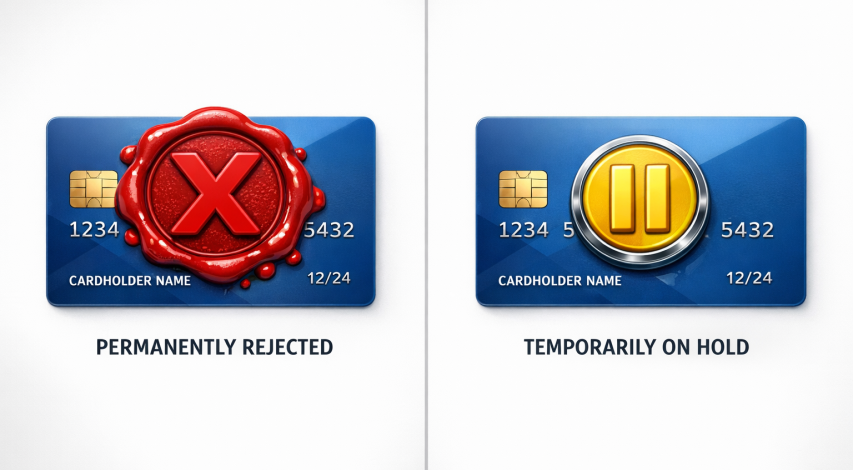
Not all declines work the same way, and this distinction legitimately changes what a business should do next. A hard decline is a permanent rejection. The card issuer is saying the transaction can't go through under any circumstances - the card is cancelled, the account is closed, or the card number is flagged as fraudulent. Retrying a hard decline won't change the outcome.
A soft decline is different - it's a temporary block, and the underlying issue may go away on its own. Insufficient funds, a bank timeout, or a card that's temporarily frozen can all cause soft declines that resolve within hours or days. That means a retry at the right time may succeed.
A quick comparison makes this concrete.
| Hard Declines | Soft Declines |
|---|---|
| Permanent rejection | Temporary block |
| Card cancelled or closed | Insufficient funds |
| Account flagged for fraud | Bank timeout or processing error |
| Do not retry | Retry may succeed |
| Contact the customer | Wait and try again |
The danger with hard declines is in how a business responds to them. Retrying a hard decline repeatedly can look suspicious to card networks and may trigger a fraud flag on the merchant account; it's a problem that goes well past one lost transaction.
Soft declines call for a better retry strategy instead of an immediate re-attempt. Waiting a day or two before retrying gives the customer time to top up their account or for a bank hold to lift. The two decline types need two different responses, and treating them the same way is where things go wrong. Learn more about how soft vs hard descriptors factor into how transactions are identified and processed.
How Decline Rates Hit Subscription Businesses Differently
Subscription businesses work on recurring billing, which means they run the same card again and again over months or years. That gives you a problem that one-time purchases never have to deal with: cards change, and the billing just keeps going.
Around 30% of credit cards are reissued every year because of fraud, data breaches, or natural expiration, and each reissue means a new card number, and unless the customer updates their details, the next billing cycle hits a dead end. This is one big reason why subscription businesses see decline rates between 18% and 20% - far higher than most other business models.
The customer usually has no idea it happened. There's no moment at checkout where they see a rejection screen. The payment quietly fails in the background, and the customer continues to feel like an active subscriber until the business comes in to flag it.
By the time anyone acts on it, the damage has already started. A single missed payment can set off a chain of downstream effects.
- The customer loses access to the product or service, often without warning.
- The business loses revenue it was counting on for that billing period.
- Customer support load increases as confused users try to understand why their access stopped.
- The relationship with the customer weakens, even though they did nothing wrong.
- Involuntary churn rises - meaning the business loses subscribers not because they wanted to leave, but because a payment failed.
Involuntary churn is worth mentioning because it's easy to misread. On paper it looks like a customer who chose to leave. But it was actually a billing failure that no one caught in time.
That is what makes decline rate management a different challenge for subscription businesses - the exposure is built into the model itself.
Steps to Reduce Your Business's Decline Rate
The good news is that most soft declines are recoverable - you just need the right tools in place before they happen.
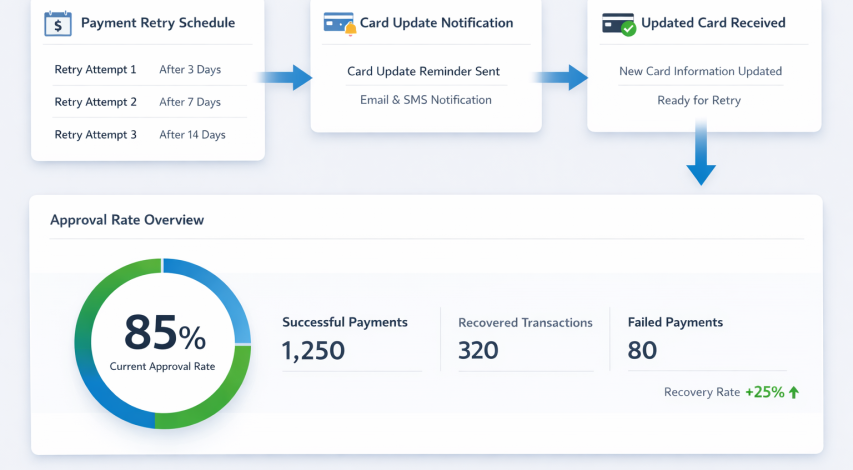
One of the most helpful moves is to set up retry logic - it means spacing out retry attempts for soft declines instead of hitting the card again immediately. Retrying too fast tells card networks that something is off, and that can hurt your standing as a merchant. A staggered schedule - waiting a day or two between attempts - tends to work much better.
Account updater services are worth a deeper look as well. These tools automatically pull refreshed card details when a customer gets a new card number or expiration date. You never have to chase the customer down, and the payment just goes through. Most payment processors and card networks have their own version of this service.

Pre-dunning is another helpful step, and that's especially useful for subscription businesses - it means sending a heads-up to customers before their card is about to be charged, giving them a chance to update their payment details in advance. A short email a few days before renewal can prevent a decline from happening.
It's also worth looking over your payment routing setup. Some processors let you route transactions through different acquiring banks to improve approval rates. A transaction that gets declined through one path might go through cleanly on another, so it pays to ask your processor what options are available. Fast approval options can make a real difference here.
Speed matters too. Research puts the abandonment rate at as high as 40% after a failed payment, which means slow or clunky recovery flows lose customers fast. The easier you make it for customers to update their details and retry, the better your chances of keeping that sale.
These systems need some upfront work. But the recovery rates make it well worth the effort.
Keeping Your Decline Rate from Becoming a Revenue Leak
If you haven't looked closely at your decline data, that's the most helpful place to start. Pull your reports, separate soft declines from hard ones, and look for patterns - a spike on card networks, a recurring issue with subscription renewals, a drop with a checkout flow. The numbers will tell you something helpful if you give them a chance to.
Most importantly, try to resist treating every decline as a closed door. A decline is usually just a signal - a card that needs updating, a transaction that tripped the wrong rule, a customer who still wants what you're selling. Read those tells correctly and you'll recover lost revenue and build a payment experience that works harder for your business and feels smoother for the customers trusting you with their money.
FAQs
What is a credit card decline rate?
A credit card decline rate is the percentage of card transactions that fail to process successfully. It's calculated by dividing declined transactions by total attempted transactions, then multiplying by 100.
What are the most common reasons cards get declined?
The three main causes are insufficient funds (~47%), issuer or fraud blocks (~27%), and invalid or expired card data (~18-20%). Insufficient funds is the leading cause and is largely outside a merchant's control.
What is the difference between hard and soft declines?
A hard decline is a permanent rejection where retrying won't help, such as a cancelled card. A soft decline is temporary, such as insufficient funds, where retrying after a short wait may succeed.
Why do subscription businesses have higher decline rates?
Around 30% of credit cards are reissued annually, meaning recurring billing often hits outdated card details. This quietly causes payment failures and involuntary churn without the customer even realizing it.
How can merchants reduce their decline rate?
Key strategies include using retry logic with staggered attempts, enrolling in account updater services to capture new card details automatically, sending pre-dunning emails before renewals, and optimizing payment routing through your processor.