 Call (844) NO-DISPUTES
What is a Payment Aggregator?
Payment aggregators have quietly reshaped how businesses of all sizes get paid. They sit between merchants and the traditional banking infrastructure, taking care of the heavy lifting so accepting credit cards, debit cards, and online wallets doesn't require a direct relationship with a bank or card network.
If you've ever used Square, Stripe, or PayPal to process a payment, you've already worked with one. But understanding what a payment aggregator is - how it's different from a traditional merchant account, what it costs, and when it makes sense to use one - helps you make better decisions about your payment infrastructure.
I'll break it all down, starting with the basics and building toward a picture of where payment aggregators fit in today's payments landscape.
How a Payment Aggregator Actually Works
When a customer hits "pay," quite a bit happens in a few seconds. The payment aggregator sits in the middle of that process - between you, the merchant, and the card networks like Visa or Mastercard.
The thing that matters to know is the master merchant account. Instead of giving each business its own dedicated merchant account, a payment aggregator holds one large account and pools all its merchants underneath it. Your business processes payments through them - not directly through a bank or card network.
What Happens at Checkout
Here's the basic flow from the second a customer pays to the second money lands in your account.
- The customer enters their card details at checkout.
- The aggregator's payment gateway captures and encrypts that data.
- The transaction is sent to the card network for authorization.
- The customer's bank approves or declines the payment.
- The aggregator receives the funds into its master merchant account.
- It then passes your share to your business account, minus its fee.
You never touch the card networks. The aggregator handles that relationship on your behalf, which is why getting started is so fast.
Why Businesses Go This Route
Setup with a payment aggregator can take minutes instead of days or weeks. There's no long bank application to fill out and no underwriting process to get through before you can take your first payment. For a new business or a side project, that speed matters.
The tradeoff is control. Because you're operating under someone else's master account, the aggregator sets the rules - on pricing, on what you can sell, and on how fast funds are released to you. You don't have a direct relationship with the bank, so you have less room to negotiate terms or push back if something goes wrong.
For small or new businesses, a traditional direct processor loses out on one point that matters: getting paid fast beats having perfect terms. But as a business grows, those tradeoffs start to look different - it's worth a look in the next section.
Payment Aggregators vs. Traditional Merchant Accounts
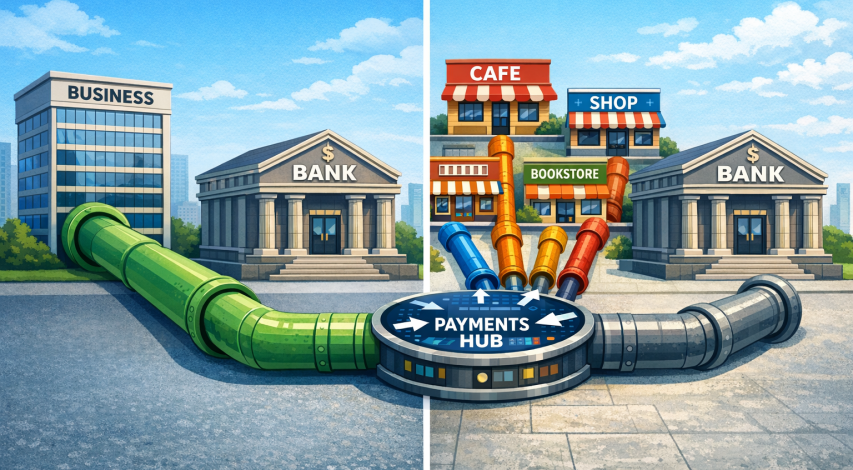
A traditional merchant account is a direct relationship between a business and an acquiring bank. The business applies, gets approved as its own merchant entity, and receives its own dedicated account for payment processing - it takes longer to set up. But the business has more direct control over its funds and fewer restrictions on transaction volume.
Payment aggregators flip that model. Instead of giving each business its own merchant account, the aggregator pools everyone under a single master account; it's what makes onboarding so fast - but it also means you're sharing infrastructure with thousands of other businesses. A company like this is also known as a payment facilitator.
| Feature | Payment Aggregator | Merchant Account |
|---|---|---|
| Setup time | Minutes to a few days | Weeks or longer |
| Fees | Flat-rate per transaction | Interchange-plus or negotiated rates |
| Fund holding risk | Higher - aggregator can hold funds | Lower - funds go directly to your account |
| Volume limits | May apply, especially at higher volumes | Generally no cap once approved |
For a small business just starting out, an aggregator is usually the easier path. The flat-rate fees are easy to predict and you don't need to negotiate anything before your first sale. A dedicated merchant account makes more sense once your monthly volume grows large enough that a negotiated rate would cost you less than a flat percentage on every transaction.
The point at which a business outgrows an aggregator has no single answer. But high-volume sellers find that flat fees add up, and that volume restrictions start to get in the way of growth. A dedicated merchant account gives those businesses more room to scale without bumping into limits set by someone else's risk policies.
Payment aggregation has also become a well-regulated and mainstream model in many markets. India's Reserve Bank of India authorized aggregators nearly doubled from 22 to 46 in the financial year 2024-25 - a sign that regulators and businesses alike are embracing this model at scale.
Who Controls the Money - and What Can Go Wrong
When you get paid through an aggregator like Stripe or Square, that money doesn't land directly in your bank account immediately- it goes into a pooled account that the aggregator controls, sitting alongside funds from thousands of other businesses. The aggregator then pays you out on its own schedule, which is usually daily or weekly.
That structure works fine most of the time. But it also means the aggregator has authority over your money, and it can hold or freeze your funds if something looks wrong to them.
Aggregators use automated systems to monitor transactions, and those systems flag anything that looks unusual. A sudden spike in sales volume, a higher-than-normal refund rate, or a wave of customer disputes can all trigger a hold. Your account doesn't need to be doing anything fraudulent for this to happen - the algorithm just needs to see a pattern it doesn't like.
Common triggers for fund holds include a sudden spike in transaction volume, an above-average rate of chargebacks or refunds, selling in a product category the aggregator considers high-risk, and processing a single transaction that's much bigger than your usual amounts.

For a small business owner, a frozen account isn't just inconvenient- it can mean not being able to pay a supplier, cover payroll, or keep the lights on while you wait for a resolution. Holds can last days, and in some cases, weeks.
Terminations are also possible. Aggregators can close your account with little notice if they decide your business model falls outside what they want to support- this happens more to newer businesses or those in industries like supplements, adult content, firearms accessories, or travel services. If your account gets terminated, any funds still held by the aggregator may be withheld for an extended period while they manage disputes or chargebacks. What happens when Stripe closes your processing is a situation more merchants face than you might expect.
The tradeoff is real. Aggregators make it fast to start accepting payments. But they also retain a level of control that traditional merchant accounts don't. Knowing that going in lets you make a better call about which payment setup fits your business.
What to Look for When Choosing a Payment Aggregator
With the dangers in mind, the next step is to learn about what to look for. Not every aggregator will suit every business, and a few key things will tell you quite a bit about whether a platform fits what you're looking for.
Start with payout speed. Some aggregators hold funds for two to seven days as a standard practice, which can put pressure on smaller businesses with tight cash flow. Know the default schedule before you sign up, and check what it takes to get faster payouts.
Fee structures are worth a close look too. Most aggregators charge a flat rate per transaction. But the details matter - some add monthly fees, chargeback fees, or charges for international payments. Run the numbers against your average transaction size and volume to see what you would actually pay.
Dispute handling is another area to dig into. When a customer files a chargeback, how does the aggregator support you? Some platforms give you tools to submit evidence and track outcomes, and others leave you largely on your own - this matters more than expected, and that's also the case as your volume grows.
To put that in context: Stripe processed $1.4 trillion in payments in 2024, and PayPal reported $464 billion in total payment volume in Q1 2026 alone across 439 million active accounts. At that scale, even small gaps in dispute or compliance handling have consequences - and the same principle applies to your business at any size.
Here are the core things to check before choosing a platform.
- Payout timing and whether faster schedules are available
- Full fee breakdown including chargebacks and international transactions
- Chargeback support tools and dispute processes
- Integration options for your existing website or software
- Compliance certifications like PCI DSS
Integration compatibility is easy to forget until it becomes a problem. A platform that does not connect cleanly with your checkout, accounting software, or inventory system will cost you time and money to work around.
It also helps to remember where your business will be in six months, not just where it is now. An aggregator that works at low volume may become limiting as you scale, so factor in whether the platform can grow with you.
Is a Payment Aggregator Right for Your Business?
An aggregator could be a fit for you if...

- You're just starting out and want to accept payments without a lengthy approval process
- Your monthly transaction volume is relatively low or unpredictable
- You sell across multiple channels and value an all-in-one solution
- You don't have the technical resources to manage a direct merchant account
- Speed to market matters more than optimizing every basis point in fees
If you're ticking most of the boxes, an aggregator is likely a starting point - not a compromise. Many thriving businesses have built their early momentum on platforms like Stripe or Square and made the switch to a dedicated merchant account only when the numbers made it obvious. There's no shame in starting easy. You want to get paid reliably, learn your patterns, and scale from there. When the time comes to level up, you'll know - and you'll have the transaction history to negotiate better terms.
FAQs
What is a payment aggregator?
A payment aggregator is a company that sits between merchants and banking infrastructure, allowing businesses to accept card payments without needing their own dedicated merchant account. Examples include Stripe, Square, and PayPal.
How does a payment aggregator differ from a merchant account?
A merchant account gives your business a direct relationship with an acquiring bank. A payment aggregator pools your business under a shared master account, making setup faster but giving you less control over funds and pricing.
Can a payment aggregator freeze my funds?
Yes. Aggregators monitor transactions automatically and can hold funds if they detect unusual activity, such as a spike in sales volume, high refund rates, or chargebacks - even if no fraud has occurred.
What fees do payment aggregators charge?
Most aggregators charge a flat rate per transaction, but additional fees may apply for chargebacks, international payments, or monthly account maintenance. Always review the full fee breakdown before committing to a platform.
When should a business switch from an aggregator to a merchant account?
When your monthly transaction volume grows large enough that flat-rate fees cost more than negotiated interchange-plus pricing, a dedicated merchant account typically becomes the more cost-effective option.