 Call (844) NO-DISPUTES

F14: Missing Signature
Whether you're encountering this for the first time or trying to understand why it's surfacing in your workflow, the good news is that F14 is usually preventable. The causes are steady, the fixes are straightforward, and knowing what to look for, you can stop it before it becomes a bigger headache.
I'll walk you through what triggers an F14 flag, how to find where the signature gap occurred, and what steps to take to resolve it faster and cleanly.
What F14 Actually Means and Why Amex Uses It
F14 sits inside Amex's Fraud category, which already tells you something - it matters. It's not a billing dispute or a customer service complaint - it's a fraud claim, and Amex treats it accordingly.
The code gets applied when a cardholder says they did not authorize a card-present transaction. Card-present means the physical card was used at a terminal, not an online purchase. But without a signed receipt, the merchant has almost nothing to prove the actual cardholder was there and agreed to the charge.
A signature on a receipt does a job - it ties an actual person to an actual transaction at a specific point in time. When that signature is missing, the paper trail breaks, and Amex has no documentation to use when the cardholder says "that wasn't me."
Amex takes this seriously because their network is built on a high level of cardholder trust. If a member disputes a charge and says they never authorized it, Amex needs something concrete from the merchant's side to push back. A signed receipt is the most direct form of that evidence.

F14 is not triggered only by an absent receipt. If a receipt exists but has no signature line, or the signature is illegible to the point of being useless, Amex can still apply this code. The bar is whether the documentation confirms cardholder authorization - not just if some piece of paper exists.
That's why F14 disputes land harder on merchants than some other reason codes. The cardholder's claim is easy and hard to argue with, and the merchant's defense depends almost entirely on documentation that's either there or it isn't. There's very little middle ground to work with once the dispute arrives.
The Situations That Usually Trigger an F14 Dispute
F14 disputes don't come from nowhere. They usually trace back to a moment in a transaction where the signature step was skipped, rushed, or handled in a way that left no record.
Busy retail counters are one of the most common places this happens. A line builds up, staff move fast, and a signature prompt can get bypassed without anyone noticing. The cardholder walks away with their purchase and the merchant walks away without proof of authorization.
Hospitality businesses run into a slightly different version of this. A restaurant may add a gratuity after the original authorization, but if the amended receipt was not signed, that final amount has no cardholder approval attached to it. That gap is what an F14 dispute is built around. If you've ever dealt with a similar situation involving a charge that changed after the fact, the process for an incorrect transaction amount dispute may also be relevant.
Digital and contactless payments create their own blind spots too. Some staff believe that a tap-to-pay transaction is completely self-contained and needs no further documentation. That is not necessarily the case, and it's in higher-value transactions where Amex may still expect a signature trail.

Here are the most common triggers worth checking in your own process.
| Trigger | What Goes Wrong |
|---|---|
| Rushed checkout | Signature step skipped to speed up the line |
| Post-authorization adjustments | Tip or amended total added without a new signature |
| Contactless assumptions | Staff treat tap payments as signature-exempt by default |
| Digital workarounds | Electronic signature captured but not stored correctly |
| Phone or mail orders | No physical signature collected and no substitute documentation kept |
Electronic signatures are worth a look on their own. A signature pad or tablet capture only helps if the data is actually saved and retrievable. If your system logs it but your team can't pull it up during a dispute within the filing window, it might as well not be out there.
Your 20-Day Window to Fight Back
Once an F14 chargeback is filed, the clock starts instantly. Merchants and acquirers have just 20 days to submit a response before the dispute closes - and if you miss that deadline, you lose automatically, no matter how strong your case could be.
Twenty days is enough time, but it goes fast when tracking down documentation and coordinating with your payment processor. It helps to treat the window as three phases so nothing gets left until the last minute.

| Days | What to Focus On |
|---|---|
| Days 1-5 | Pull together all transaction records, receipts, and any cardholder communication. Contact your processor to confirm exactly what they need from you. |
| Days 6-12 | Build your rebuttal letter and organise your evidence into a clear package. Address the missing signature claim directly rather than submitting general transaction history. |
| Days 13-18 | Review everything for gaps and get the full submission ready to send. Don't wait for day 20 - processors often need a day or two to process your response on their end. |
| Days 19-20 | Buffer time only. Use these days to handle any last-minute requests from your processor, not to start building your case from scratch. |
The rebuttal letter matters more than you might expect. A disorganised submission - even one with evidence - can still cause a loss if the reviewer has to work too hard to follow it.
Submit early if you can. Getting your response in by day 15 or 16 gives your processor room to manage any issues before the deadline hits. Repeated losses can also affect your chargeback ratio, so timely, well-prepared responses matter beyond any single dispute.
What Evidence Actually Holds Up When You Dispute F14
Once you've submitted your rebuttal within that 20-day window, the quality of your evidence matters more than the quantity. Amex is looking for documentation that directly connects the cardholder to the transaction - not just proof that a sale happened.
The strongest thing you can send is a signed receipt or authorization slip. If you have that, lead with it. Transaction logs from your payment terminal also carry actual weight because they show the card was present and the charge went through a standard approval process. Cardholder verification records - like PIN entry confirmation or ID check notes - can also support your case in a real way.
| Strong Evidence | Weak Evidence |
|---|---|
| Signed sales receipt | Invoice with no signature |
| Terminal transaction log showing card-present sale | Email confirmation sent after the purchase |
| Cardholder verification record (PIN, ID check) | Internal notes not shared with the customer |
| Security footage showing the customer at point of sale | Screenshots of a customer's account or order history |
The harder situation is when you legitimately don't have a signature. That does make things more difficult, but it doesn't automatically mean you lose. You can still submit the other evidence you have and write an explanation of how the transaction was processed and why authorization was obtained through another strategy.
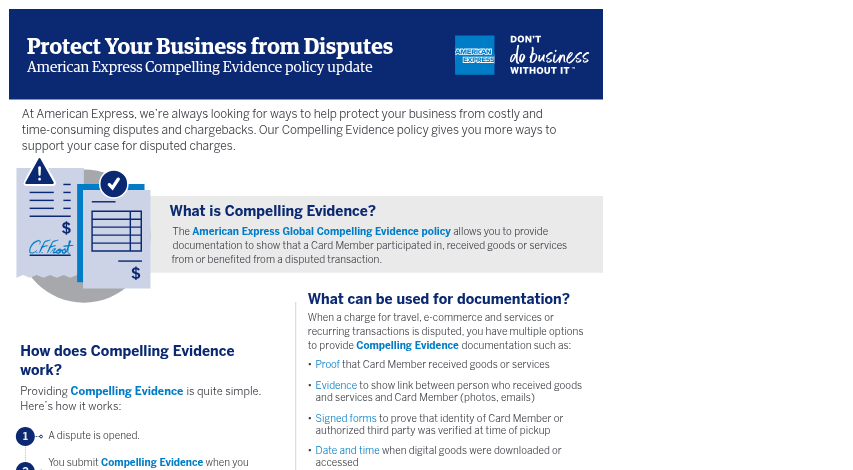
Amex will weigh everything together. A strong terminal log combined with a basic written explanation can be enough to tip the decision in your favor. What won't help is submitting vague or unrelated documents just to fill space - that undermines an otherwise decent case.
Focus on what directly proves the cardholder was there and agreed to the charge; it's what Amex is trying to establish.
Simple Fixes That Help Prevent F14 From Coming Up Again
The good news is that most F14 chargebacks come down to small process gaps instead of anything tough. Fixing those gaps now is a bit less painful than fighting disputes later.
The most direct fix is to collect a signature at the point of sale for every transaction that calls for one. Amex has card-present rules about when a signature is needed, and your terminal settings or staff habits might not be lined up with those rules - it's worth a quick audit.
Staff training matters more than merchants expect. If the person running the register doesn't know that a missing signature can cause a lost chargeback, they have no reason to make it a priority. A short refresher on Amex's card-present process can go a long way.

Receipt storage is another area that quietly costs merchants money. If you can't retrieve a signed receipt within the dispute response window, it doesn't matter that the transaction was legitimate. Keep records organized and backed up somewhere you can access them fast.
Here are a few helpful steps worth putting in place:
- Set your terminal to prompt for signatures on transactions above Amex's threshold.
- Train staff to check that the signature field is completed before the customer leaves.
- Store signed receipts digitally so they're searchable and easy to pull up quickly.
- Review your card-present setup any time you update your payment hardware or software.
None of this is tough to set up. The harder part is making it consistent, and that's especially the case in busy environments where shortcuts become habits.
Small process improvements at the point of sale cut back on F14 disputes and the time your team spends on chargebacks across the board, which frees up energy for things that move your business forward.
Don't Let a Missing Signature Cost You More Than It Should
Three things are worth carrying with you: know the code so you can respond accurately, know the clock so you never miss your window, and know your evidence so you can build a case that speaks for itself. Signature records, delivery confirmations, and cardholder communication logs aren't just paperwork - they're your defense.

Before the next dispute lands in your queue, take a few minutes to audit how your team currently collects and stores signature data. Ask if those records are easy to retrieve quickly, if your staff knows what counts as acceptable proof, and if there are any gaps in your latest flow. Small improvements made now can save a lot of time and money later. A little preparation is the best response to a dispute you haven't received yet.
FAQs
What does the F14 chargeback code mean?
F14 is an American Express fraud code applied when a cardholder claims they did not authorize a card-present transaction, and the merchant cannot provide a signed receipt as proof of authorization.
How long do merchants have to respond to F14?
Merchants have 20 days to submit a response once an F14 chargeback is filed. Missing this deadline results in an automatic loss, regardless of how strong the merchant's case may be.
What evidence is strongest when disputing F14?
A signed sales receipt is the strongest evidence. Terminal transaction logs showing a card-present sale and cardholder verification records like PIN confirmation or ID checks also carry significant weight with Amex.
What commonly triggers an F14 dispute?
Common triggers include rushed checkouts where the signature step is skipped, post-authorization tip adjustments without a new signature, and contactless payments where staff assume no signature documentation is needed.
How can merchants prevent F14 chargebacks?
Merchants should configure terminals to prompt for signatures on qualifying transactions, train staff to verify signature completion before customers leave, and store signed receipts digitally for fast retrieval during disputes.